Lithium Battery Solar Backup India | EcoSwitch
Lithium Battery & Solar Power Backup: Why Energy Storage Is the Future of India
Reliable Power for Homes, Businesses & Industries | Bihar, Jharkhand & All India
India is rapidly moving toward solar energy, electric mobility, and smarter energy solutions. However, solar panels alone are not always enough to provide reliable electricity throughout the day. Power cuts, voltage fluctuations, rising electricity demand, and increasing dependence on electrical equipment make battery energy storage and power backup increasingly important.
For homes, businesses, hospitals, offices, factories, schools, and commercial buildings, lithium battery technology is becoming one of the most advanced solutions for storing electricity and ensuring reliable backup power.
In states like Bihar and Jharkhand, where residential electricity demand is growing and businesses require reliable power for daily operations, combining solar energy with lithium battery storage can create a more dependable and efficient energy system.
EcoSwitch provides solar energy, power backup, battery storage planning, residential solar, commercial solar EPC, industrial energy solutions, and intelligent solar services designed for India's evolving energy needs.
1. What Is a Lithium Battery Power Backup System?
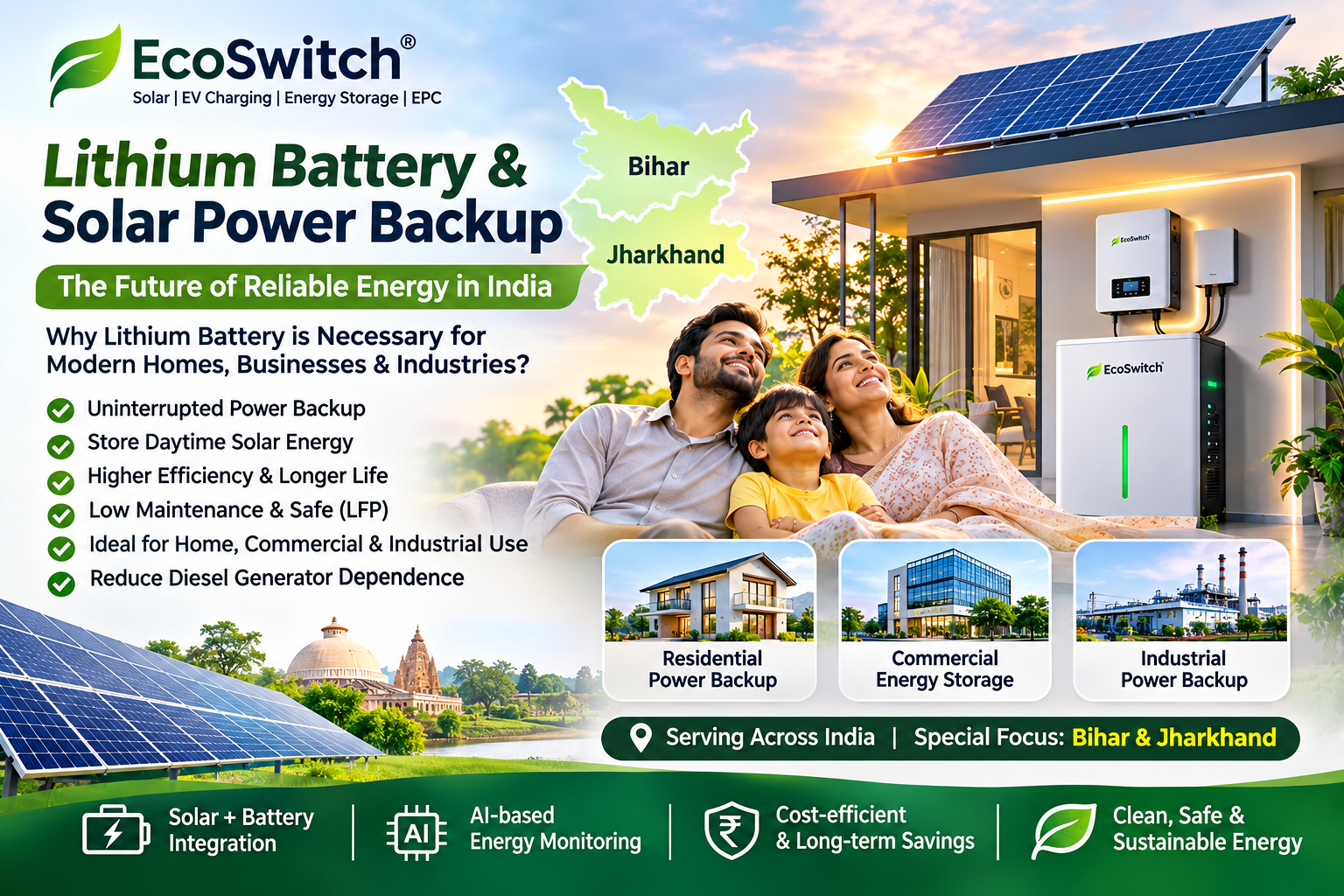
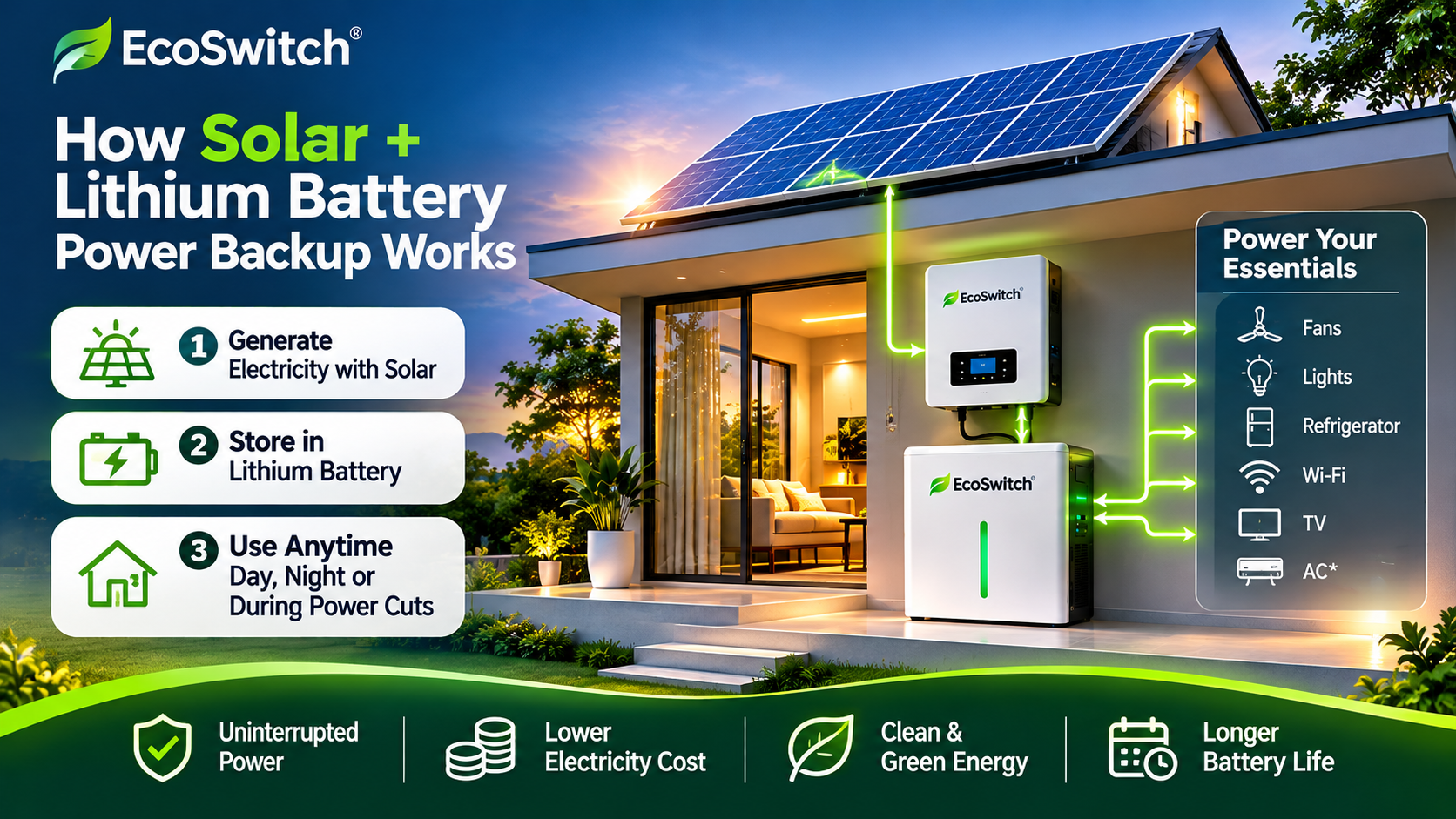
A lithium battery backup system is an advanced energy storage solution that stores electricity for use when grid power is unavailable or when stored solar energy is needed.
Unlike traditional inverter batteries, modern lithium battery systems use advanced Battery Management Systems (BMS) to monitor charging, discharging, temperature, voltage, and battery health.
When connected with a solar system, a battery can:
-
Store surplus solar electricity generated during the daytime.
-
Supply electricity during power cuts.
-
Power essential appliances at night.
-
Reduce dependence on diesel generators in suitable applications.
-
Support critical equipment during grid failures.
-
Improve energy independence.
-
Help manage electricity consumption more efficiently.
For modern homes and industries, lithium battery storage is not just a backup device — it is an important component of an intelligent energy system.
2. Why Lithium Batteries Are Better Than Traditional Lead-Acid Batteries
Traditional lead-acid batteries have been used for years in homes, shops, and offices. But energy requirements have changed.
Today, homes use air conditioners, refrigerators, computers, smart TVs, pumps, Wi-Fi systems, and multiple electronic devices. Commercial businesses use billing machines, CCTV, servers, networking equipment, and automation systems.
This requires a more efficient and advanced energy storage solution.
Lithium vs. Traditional Inverter Batteries
| Feature | Lithium (LFP) | Lead-Acid |
|---|---|---|
| Lifespan | Generally longer | Generally shorter |
| Charging speed | Faster, model dependent | Usually slower |
| Maintenance | Low | Often requires maintenance |
| Usable capacity | Typically higher | Typically lower |
| Weight | Lighter | Heavier |
| Cycle life | High, model dependent | Generally lower |
| Monitoring | Advanced BMS options | Usually limited |
| Installation footprint | Compact options | Often larger |
| Solar compatibility | Excellent with compatible systems | Compatible with many systems |
| Long-term use | Suitable for frequent cycling | Budget-conscious backup use |
Lithium batteries, especially Lithium Iron Phosphate (LiFePO₄ or LFP), are increasingly popular for stationary energy storage because of their cycle life, energy efficiency, and suitability for repeated charging and discharging.
Actual performance depends on battery quality, temperature, operating conditions, charging profile, inverter compatibility, and warranty terms.
3. Why Lithium Battery Storage Is Necessary for the Future of Solar Energy
Solar energy is one of the most sustainable ways to generate electricity. However, solar generation changes with sunlight.
A rooftop solar system generally produces the most electricity during the daytime, while many homes consume more power in the evening and at night.
This creates an energy gap.
Solar Generation vs. Electricity Consumption
-
Morning: Solar generation starts increasing.
-
Afternoon: Solar generation reaches its peak.
-
Evening: Solar generation drops while household demand may increase.
-
Night: Solar generation becomes zero, but electricity demand continues.
A lithium battery solves this problem by storing energy when it is available and delivering it when it is needed.
Why Solar + Lithium Battery Is a Powerful Combination
A properly designed solar battery system can help:
-
Store daytime solar energy for nighttime consumption.
-
Maintain essential loads during outages.
-
Improve utilization of generated solar electricity.
-
Support critical equipment during grid failure.
-
Reduce generator running hours where feasible.
The future of solar energy is not only about generating electricity. It is about generating, storing, managing, and using energy intelligently.
4. Why Residential Homes in India Need Lithium Battery Backup
For Indian residential customers, reliable electricity is important for comfort, safety, education, and everyday life.
Applications of Residential Lithium Battery Backup
-
Fans and lighting
-
Refrigerator
-
Wi-Fi router and internet connectivity
-
Television and entertainment systems
-
Computers and work-from-home equipment
-
CCTV and security systems
-
Water pumps, where properly sized
-
Selected air conditioners, with suitably designed systems
In Bihar and Jharkhand, backup power can be especially valuable for families dealing with outages, rural electricity challenges, voltage instability, or businesses operating from home.
Solar Battery Backup for Modern Homes
Daytime: Solar panels supply home loads and charge the battery.
Evening: Stored battery power supports selected appliances.
Power cut: A compatible backup inverter switches to battery power according to its configuration and supported loads.
Grid restoration: The system resumes charging according to programmed settings and available energy.
A correctly sized battery can make a home more comfortable, energy-efficient, and prepared for unexpected power interruptions.
5. Lithium Battery Backup for Commercial Businesses
Power interruptions can cause financial losses for businesses.
A small power interruption can affect:
-
Billing and POS systems
-
Internet connectivity
-
CCTV cameras
-
Office computers
-
Servers and networking equipment
-
Manufacturing operations
-
Customer service
-
Productivity
For commercial businesses, a lithium backup system can help maintain business continuity.
Businesses That Can Benefit
-
Retail shops and showrooms
-
Hotels and restaurants
-
Clinics and diagnostic centers
-
Offices and coworking spaces
-
Schools and colleges
-
Warehouses
-
Petrol pumps
-
Banks and financial offices
-
Telecom infrastructure
-
Small manufacturing businesses
Solar with lithium battery backup can help businesses reduce dependence on conventional backup systems and manage their energy needs more efficiently.
6. Industrial Lithium Battery Energy Storage – The Next Big Opportunity
Industrial facilities need reliable electricity to maintain production, protect equipment, and avoid downtime.
Factories may experience losses due to:
-
Sudden electricity interruptions
-
Production line shutdowns
-
Equipment restart delays
-
Data loss
-
Material wastage
-
Unplanned maintenance
-
Diesel generator fuel costs
For industrial facilities, a Battery Energy Storage System (BESS) can be designed to support critical electrical loads, manage power interruptions, and integrate renewable energy.
Industrial Battery Storage Applications
| Application | Potential benefit |
|---|---|
| Factory backup | Support critical machinery and processes |
| Solar energy storage | Store surplus solar generation |
| Critical-load backup | Maintain selected essential systems |
| Diesel generator support | Reduce generator operating hours where feasible |
| Peak load management | Support demand management strategies |
| IT & automation | Protect controls, PLCs, servers and networks |
| Warehouse backup | Maintain lighting, systems and selected equipment |
| Commercial campus | Centralized energy storage and management |
Industrial battery backup should always be designed after evaluating load profile, starting currents, power quality, backup duration, inverter capacity, safety requirements, and site conditions.
7. India's Solar & Battery Storage Market Outlook: 2027–2030
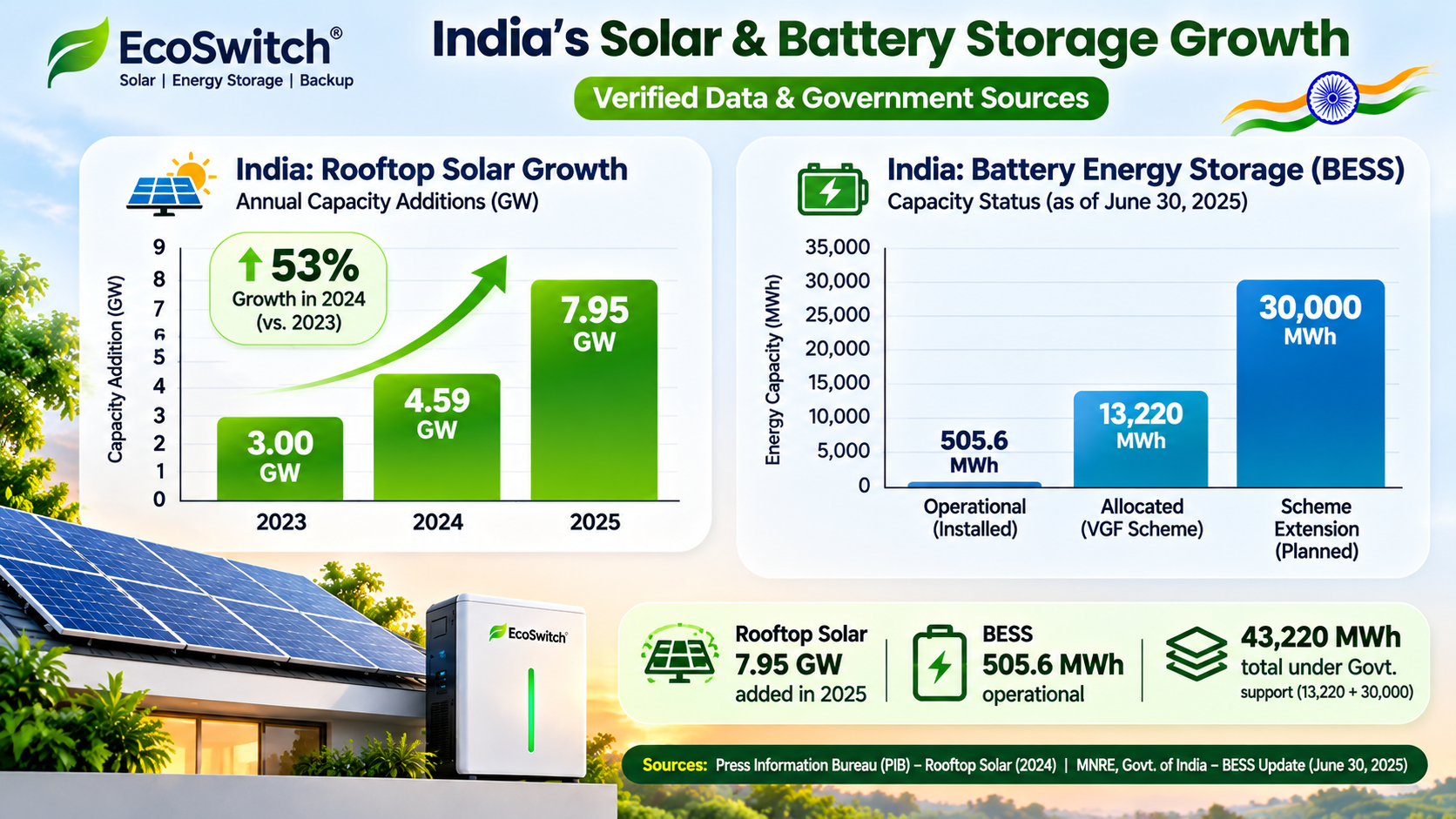
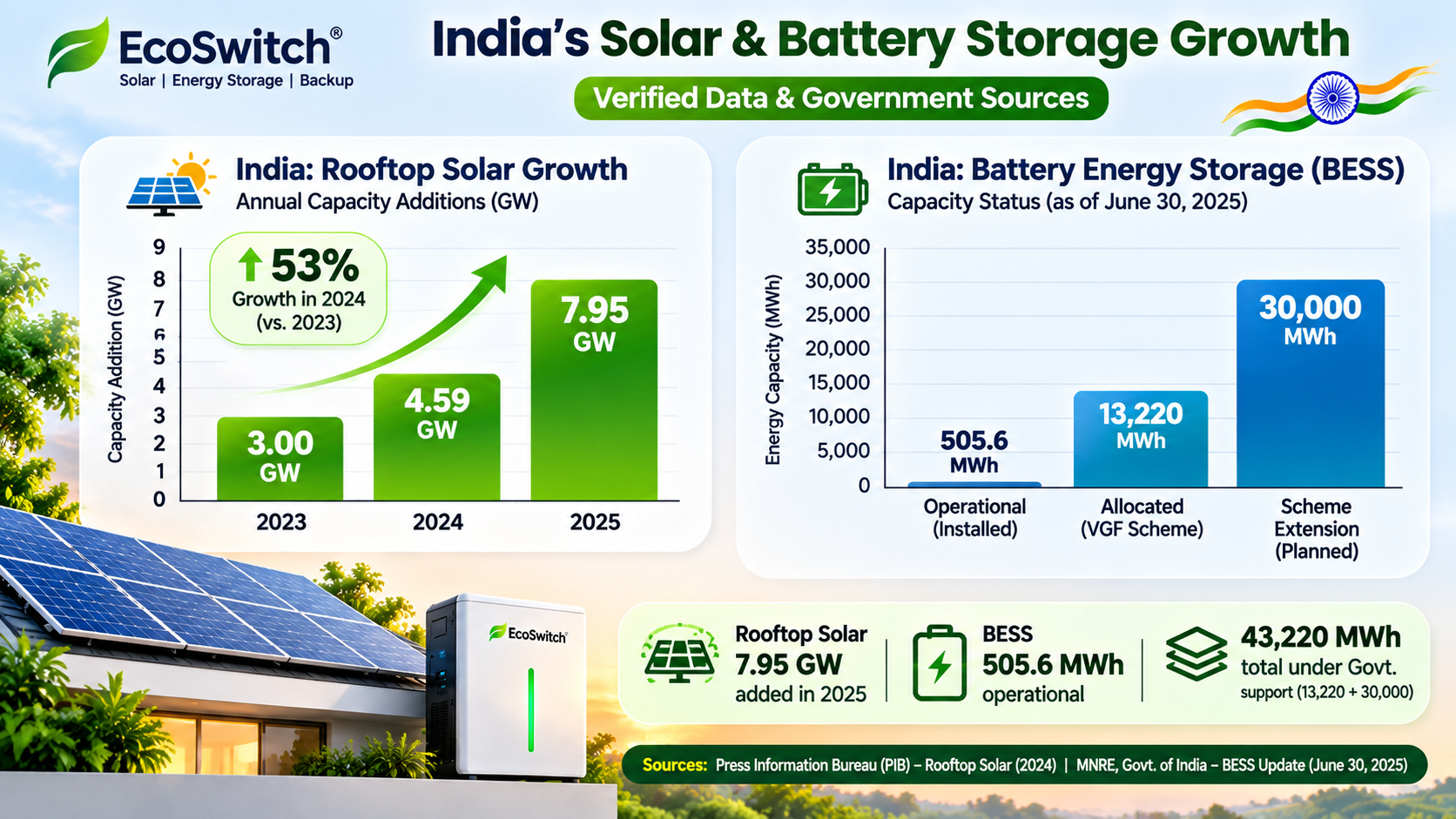
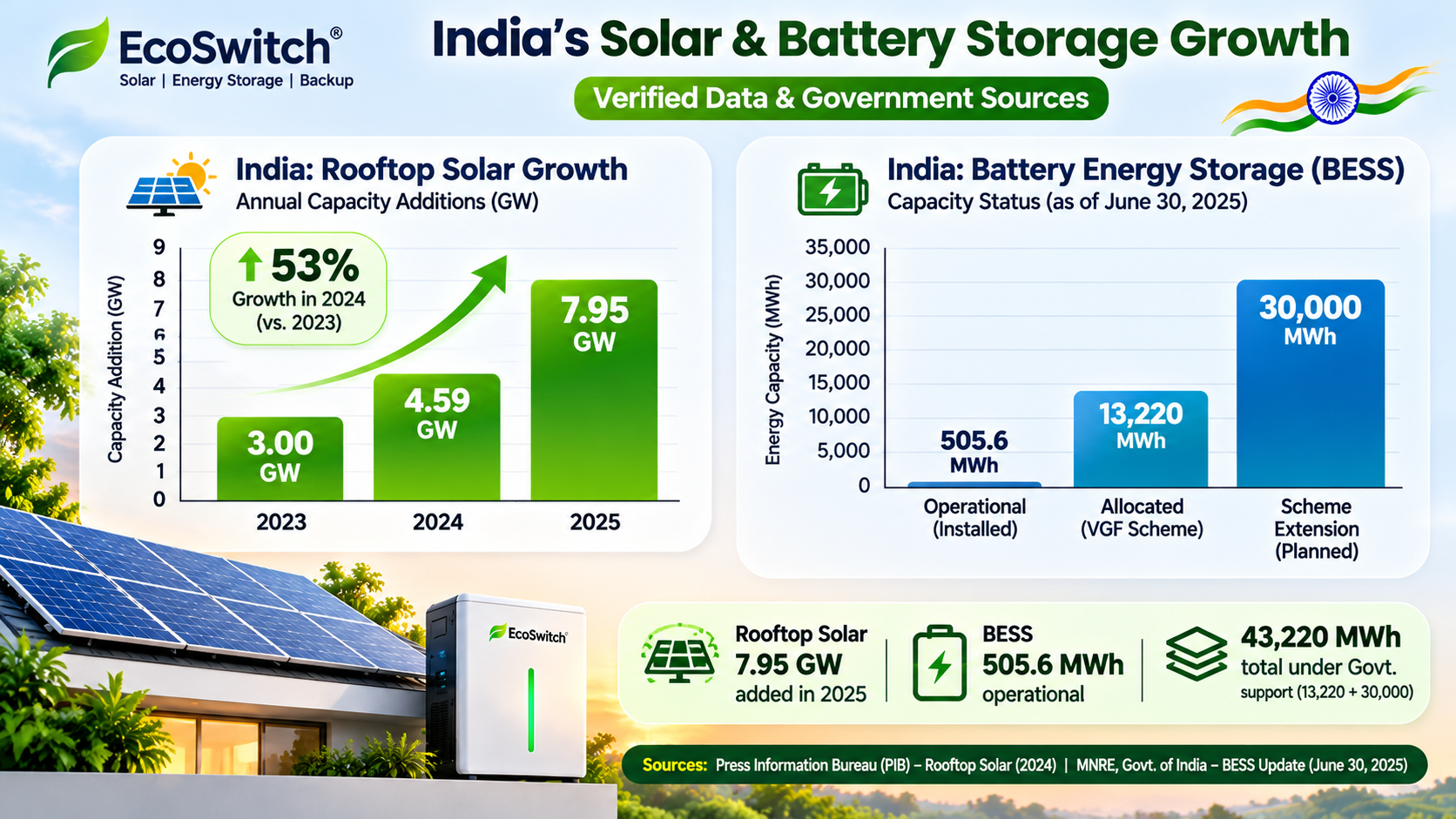
India is entering a major transformation in renewable energy. Solar power is expanding rapidly, and energy storage is becoming increasingly important to support reliable electricity supply, grid stability, residential power backup, industrial energy requirements, and renewable energy integration.
According to Central Electricity Authority (CEA) planning projections for 2029–30, India's solar capacity is expected to reach approximately 292.56 GW, while Battery Energy Storage Systems (BESS) are projected at approximately 41.65 GW / 208.25 GWh.
These projections highlight the growing role of battery storage in India's future energy infrastructure.
India's projected energy landscape by 2030
-
292.56 GW — projected solar installed capacity
-
41.65 GW — projected BESS power capacity
-
208.25 GWh — projected BESS energy storage capacity
-
60.63 GW — total storage power capacity requirement including battery storage and pumped storage
These are planning projections, not guarantees of actual installed capacity.
Why India's energy storage market is expected to grow
The increasing adoption of renewable energy creates a greater need for flexibility in how electricity is generated, stored, and consumed.
Solar power is available during daylight hours, but demand continues in the evening and night. Battery energy storage can help bridge this gap by storing electricity and delivering it when needed.
Growing demand for:
-
Residential solar systems
-
Commercial rooftop solar
-
Industrial solar EPC projects
-
Electric vehicles and charging infrastructure
-
Reliable power backup
-
Energy management and peak-load support
-
Grid-scale renewable integration
is increasing the importance of battery storage technologies.
What the 2030 outlook means for lithium batteries
The expected expansion of solar energy creates an important opportunity for lithium battery technology.
As solar installations grow, consumers may increasingly consider:
-
Solar battery backup for homes
-
Hybrid solar inverter systems
-
Lithium battery inverter upgrades
-
Commercial battery storage
-
Industrial BESS projects
-
Solar + battery systems for energy independence
Battery storage is becoming an important part of the energy transition — from individual homes to large industrial and grid applications.
Market figures are CEA planning estimates for FY 2029–30. They should not be interpreted as achieved capacity or guaranteed market outcomes. Forecast growth between individual years is illustrative unless backed by published annual projections.
8. Why Solar Battery Backup Is Especially Important for Bihar & Jharkhand
Bihar and Jharkhand are developing rapidly. Urban expansion, industrial growth, new commercial establishments, educational institutions, hospitals, and rising household electricity consumption are increasing the need for dependable energy solutions.
Customers in cities such as Patna, Gaya, Muzaffarpur, Bhagalpur, Ranchi, Bokaro, Dhanbad, Jamshedpur, and Deoghar are increasingly exploring rooftop solar, inverter upgrades, battery storage, and energy independence.
Why Bihar and Jharkhand Customers Should Consider Lithium Backup
-
Reliable electricity for homes and businesses.
-
Backup during unexpected power cuts.
-
Support for solar-powered homes.
-
Reduced generator dependency in suitable applications.
-
Modern energy storage with compact installation options.
-
Better support for digital businesses and home offices.
-
Reliable power for security systems and essential equipment.
Cities We Serve
Bihar: Patna, Muzaffarpur, Gaya, Bhagalpur, Darbhanga, Purnia, Begusarai, Ara, Bihar Sharif, Chapra, Siwan, Motihari, Bettiah, Bagaha, Hajipur, Samastipur, Sasaram, Aurangabad and Kishanganj.
Jharkhand: Ranchi, Dhanbad, Bokaro, Jamshedpur, Deoghar, Hazaribagh, Giridih, Ramgarh, Dumka, Chaibasa, Medininagar and Koderma.
For homes and industries in these regions, solar energy combined with battery storage can provide a smarter way to prepare for energy challenges.
9. Why Choose EcoSwitch for Residential Power Backup?
EcoSwitch focuses on solar energy, power backup, EV charging, energy solutions, and intelligent solar services.
Our objective is not simply to sell a battery. We aim to help customers understand their energy requirements and select a backup system that makes practical sense.
EcoSwitch Residential Power Backup Solutions
-
Residential lithium battery installation
-
Solar + lithium battery integration
-
Hybrid inverter solutions
-
Home backup system design
-
Essential-load backup planning
-
Solar system expansion consultation
-
Battery capacity planning
-
Technical support and service assistance
-
Energy monitoring and intelligent solar diagnostics, where supported
Why EcoSwitch?
Customized system design: We help evaluate actual consumption, backup requirements, and essential appliances before recommending a system.
Solar + backup expertise: We help plan integrated solutions combining solar panels, hybrid inverters, batteries, and electrical protection.
Residential and commercial solutions: From small home backup systems to larger business installations, system design can be matched to your requirements.
Future-ready energy planning: Our focus is on systems that can support future energy needs, subject to equipment compatibility and upgrade options.
Service-oriented approach: Power backup systems need more than installation. Proper commissioning, monitoring, technical support, and maintenance guidance matter.
10. Why EcoSwitch for Industrial Power Backup?
Industrial customers need technical planning rather than generic battery recommendations.
EcoSwitch can assist businesses in evaluating energy requirements and designing a backup solution around their operational priorities.
Our Industrial Energy Approach
-
Load analysis and critical-load identification
-
Solar EPC integration
-
Lithium battery energy storage planning
-
Hybrid inverter and power conversion solutions
-
Commercial and industrial backup
-
Factory and warehouse energy solutions
-
System expansion planning
-
Power backup for selected critical machinery
-
Solar monitoring and service support
Whether you operate a factory in Bokaro, Dhanbad, Jamshedpur, Ranchi, Patna, Muzaffarpur, or another industrial location, choosing the right backup architecture can help protect operational continuity.
For larger installations, EcoSwitch can evaluate the feasibility of battery energy storage systems, solar integration, and generator coordination.
11. How Much Lithium Battery Backup Does Your Home Need?
The right capacity depends on which appliances you want to run and for how long.
Example Residential Backup Configurations
| Home requirement | Suggested starting point for assessment |
|---|---|
| Lights, fans, Wi-Fi | 1–2 kWh |
| Basic household essentials | 2–5 kWh |
| Larger household backup | 5–10 kWh |
| Refrigerator, fans, lights and selected loads | 5–10 kWh or more |
| Air conditioning backup | Requires detailed load and surge calculation |
| Whole-home backup | Customized based on total demand |
These are illustrative starting points, not final battery sizing recommendations.
Example Calculation
Suppose your essential appliances consume approximately 800 watts and you need 5 hours of backup.
Energy required:
800 W × 5 hours = 4,000 Wh = 4 kWh
That means approximately 4 kWh of usable energy is required before accounting for inverter losses, operating reserve, and battery sizing margins.
The battery's nominal capacity will generally need to be higher than the usable energy requirement.
This is why EcoSwitch recommends proper load calculation rather than selecting a battery only based on price or kWh rating.
12. Lithium Battery vs Diesel Generator: A Smarter Backup Strategy
Diesel generators have long been used for industrial and commercial backup. But fuel expenses, noise, exhaust emissions, servicing, and maintenance can make frequent backup operation costly and inconvenient.
A lithium battery backup system offers an alternative for many applications.
| Factor | Lithium Battery Backup | Diesel Generator |
|---|---|---|
| Noise | Quiet operation | Noisy |
| Exhaust emissions at site | No exhaust during battery operation | Exhaust emissions |
| Fuel | No diesel fuel required | Requires diesel |
| Maintenance | Battery and electronics maintenance | Engine maintenance |
| Response | Fast, system dependent | Startup and stabilization |
| Solar integration | Excellent with compatible systems | Limited without hybrid integration |
| Best use | Frequent backup and solar storage | Long-duration backup and high-power applications |
For industrial sites, lithium batteries and diesel generators can also work together. A battery may handle short outages and frequent backup events while the generator remains available for extended outages or loads beyond the battery system's capability.
This hybrid strategy can help reduce generator operating hours when designed appropriately.
13. Lithium Batteries and PM Surya Ghar Rooftop Solar
India's rooftop solar ecosystem is expanding, and residential consumers are becoming more aware of the benefits of solar energy.
Solar systems can help generate electricity and reduce dependence on grid power. However, consumers should understand an important point:
A typical grid-connected rooftop solar system does not automatically provide backup power during a grid outage.
Many grid-connected solar inverters shut down during a grid failure to prevent unsafe backfeeding. If a customer wants backup power, the system needs appropriate backup-capable equipment, such as a compatible hybrid inverter, battery storage, and properly configured backup circuits.
This is an important consideration for customers installing rooftop solar under the PM Surya Ghar scheme or other residential solar programs.
Before installing a solar system, ask:
-
Will my solar system work during a power cut?
-
Can I add a lithium battery later?
-
Is my inverter compatible with battery storage?
-
Which appliances can run during backup?
-
Can I run AC during battery backup?
-
How much battery capacity do I need?
-
Does the system have a backup output?
-
What protection and safety equipment is included?
EcoSwitch can help customers evaluate these questions before choosing their residential solar and backup system.
14. What to Check Before Buying a Lithium Battery in India
Don't select a lithium battery based only on price.
Before purchasing, check:
-
Battery chemistry — LFP is commonly considered for stationary storage.
-
Battery capacity — rated kWh and usable kWh.
-
Battery management system (BMS).
-
Compatible inverter voltage and communication protocols.
-
Charging and discharging current ratings.
-
Cycle-life warranty conditions.
-
Warranty duration and exclusions.
-
Thermal protection and installation requirements.
-
Certifications applicable to the product.
-
Manufacturer and service support.
-
Battery expansion compatibility.
-
Installation and electrical protection.
-
Proper ventilation, clearances, and fire-safety provisions as required by the equipment and installation design.
A quality battery with proper installation and support is a better investment than a low-cost product with unclear specifications or no reliable service network.
15. The Future of Power Backup Is Solar + Lithium + Smart Energy Management
The next generation of energy systems will combine several technologies:
-
Solar panels
-
Lithium battery storage
-
Smart hybrid inverters
-
EV charging infrastructure
-
AI-based energy monitoring
-
Intelligent load management
-
Remote diagnostics
-
Grid connectivity
-
Automated energy management
Imagine a home that generates solar electricity during the day, charges its battery automatically, powers essential appliances in the evening, and charges an electric vehicle using intelligently managed energy.
Imagine a factory that stores solar power, maintains critical operations during outages, monitors energy consumption, and reduces its reliance on diesel backup.
This is the direction energy technology is moving toward.
EcoSwitch believes the future belongs to customers who invest in smarter energy systems — not only in solar panels, but also in storage, backup, monitoring, and intelligent energy management.
16. Why EcoSwitch Is a Smart Choice for Solar & Lithium Power Backup
EcoSwitch is building an integrated clean-energy ecosystem for residential, commercial, and industrial customers across India.
Our solutions focus on helping customers move toward:
-
Reliable electricity
-
Solar energy
-
Lithium battery storage
-
Smart power backup
-
Commercial and industrial energy solutions
-
EV charging infrastructure
-
AI-powered solar diagnostics and monitoring
Whether you are planning a new home, upgrading your existing inverter, installing rooftop solar, opening a commercial business, or operating a factory, EcoSwitch can help you explore a suitable power backup solution.
Switch to Smarter Power. Switch to EcoSwitch.
Reliable Energy for Homes, Businesses & Industries
Solar Energy | Lithium Battery Backup | Industrial Energy Storage | EV Charging
Website: https://ecoswitch.io/
Email: support@ecoswitch.io
Serving customers across Bihar, Jharkhand and India.
Frequently Asked Questions (FAQs)
1. Is lithium battery better than a normal inverter battery for home?
Lithium batteries, especially LFP batteries, can provide longer cycle life, faster charging, higher usable energy, and lower maintenance than many traditional lead-acid batteries. The best choice depends on your budget, backup requirement, and usage frequency.
2. Can I use a lithium battery with my existing solar panels?
Yes, in many cases, but your inverter must support the battery's voltage, charging requirements, and communication or control system. Compatibility should be verified before installation.
3. How many hours can a lithium battery provide backup?
Backup duration depends on the battery's usable capacity and connected load. A 5 kWh battery will provide different backup durations depending on whether your appliances consume 500 watts or 2,000 watts.
4. Can lithium batteries run an AC during a power cut?
Yes, appropriately designed systems can run air conditioners, but the battery capacity, inverter power rating, AC starting surge, and desired runtime must be considered. A small battery may not provide sufficient backup.
5. Is lithium battery backup useful in Bihar?
Yes. Residential customers, offices, shops, clinics, schools, and industries across Bihar can benefit from reliable battery backup, particularly where uninterrupted electricity is important.
6. Is lithium battery backup suitable for factories?
Yes. Commercial and industrial battery energy storage systems can support selected critical loads, solar integration, power continuity, and energy management. Industrial projects require detailed electrical and load analysis.
7. Can solar panels charge lithium batteries?
Yes. Solar panels can charge lithium batteries using a compatible hybrid inverter or solar charge controller with the correct battery charging configuration.
8. Does PM Surya Ghar solar provide backup during power cuts?
Not automatically. Standard grid-connected solar installations typically shut down during grid outages. Battery backup requires compatible backup-capable equipment and an appropriate system design.
9. What is India's projected solar capacity by 2030?
CEA planning projections for FY 2029–30 indicate approximately 292.56 GW of solar capacity. This is a planning projection, not a guarantee of actual installed capacity.
10. What is India's projected battery energy storage capacity by 2030?
CEA planning projections indicate approximately 41.65 GW / 208.25 GWh of BESS capacity by FY 2029–30. This represents planned system requirements, not necessarily installed capacity.
11. Where does EcoSwitch provide solar battery backup solutions?
EcoSwitch serves solar and power backup requirements across India, with a focus on residential, commercial, and industrial customers in Bihar, Jharkhand and other regions.